Sharing a Rail Trail With Cyclists
A rail trail can feel wide and predictable until you meet a cyclist around a bend, pass a family on foot, or discover that the surface has narrowed to one usable track. In Nova Scotia, the key is confirming that machines are allowed on that specific segment, then riding slowly and predictably around other trail users. This guide covers planning, passing, and sharing the corridor courteously.
Confirm that the rail trail allows ATVs and UTVs
Treat each trail segment as its own route
“Rail trail” describes a corridor’s history, not a blanket permission for every kind of travel. Some sections may welcome off-highway vehicles, while others may be limited to pedestrians, cyclists, or other users. Access can also change along a route, so permission on one stretch does not automatically carry over to the next.
Before you unload, check the route and its access rules for the exact segment you intend to ride. Look for signs at the trailhead and at intersections, and check for current notices about closures or restrictions. The guide to Nova Scotia Old Rail Lines Turned Trails gives useful context for why a former rail corridor should not be assumed to have one uniform rule from end to end.
A route-planning app such as onX Offroad can help you review possible routes and orient yourself before a ride. Use it as a planning aid, not as proof that a segment is open to ATVs or UTVs. Confirm access through the trail’s local managing organization, club, posted signage, or official trail information. This matters especially where a route crosses private land or connects with a different trail system.
Check conditions, signs, and closures before setting out
A route that was open on your last visit may have a closure, washout, temporary reroute, or seasonal restriction today. Rail corridors can also include bridges, culverts, narrow approaches, and shared access points where conditions affect safe travel. Review Nova Scotia Trail Conditions and Closures before leaving, and pay attention to signs once you reach the trail.
If an app, printed map, and trail sign appear to disagree, do not treat the most permissive option as the answer. Stop somewhere safe and check with the local club or trail authority before continuing. A trail map can be helpful for orientation, but posted restrictions and current local notices should guide your decision.
That extra check can prevent a frustrating mid-ride turnaround. It also helps avoid entering a segment where cyclists or walkers may reasonably expect a quieter, non-motorized path. For a broader look at how to interpret markers and notices, see Nova Scotia Trail Signage Explained.
Prepare for a shared trail ride
Plan for cyclists, walkers, and changing trail conditions
Rail trails can seem roomy when viewed on a map, but the usable surface may narrow because of soft shoulders, puddles, gravel, vegetation, or erosion. A cyclist approaching from the opposite direction may also be moving faster than you expect, particularly on a smooth, gradual descent. Build those possibilities into your plan rather than assuming you will always have space to pass comfortably.
Check your route before the ride and identify places where the corridor may become narrow or visibility may be limited. A map tool such as onX Offroad may help you keep track of your planned route and nearby alternatives, but it cannot replace observation on the ground. Keep the app or map available in a way that does not distract the driver, and stop in a safe place if you need to study it.
Pack for the actual conditions, not just the forecast at home. A dry rail bed can turn dusty, while a damp stretch can be slick or muddy. A UTV or ATV can throw dust, gravel, or water toward people behind or beside it, so slow down well before reaching other users. The advice in Nova Scotia Trail Etiquette Locals Expect is useful for thinking beyond the machine itself and considering how your riding affects everyone sharing the corridor.
Ride at a speed that leaves room to react
Choose a pace that lets you stop safely within the distance you can see. That means slowing down before blind curves, trail intersections, bridge approaches, and any section where vegetation or terrain blocks your view. If you cannot see far enough ahead to know whether someone is around the bend, do not ride as though the trail is empty.
Dust is a practical safety issue, not just an annoyance. If you catch up to cyclists or pedestrians, ease off early so the dust has time to settle. On a dry, open stretch, give the group room before you pass; in a confined or dusty section, wait until conditions improve. If slowing down means staying behind them for a while, that is often the safer and more courteous choice.
Keep your machine under control and avoid abrupt acceleration near people. A loud engine rev or sudden burst of speed can startle a cyclist who is balancing on loose gravel. On a narrow rail bed, predictable riding is often more reassuring than attempting to move quickly past someone simply because a gap appears.
Pass cyclists and other users safely
Slow down, make your presence clear, and wait for space
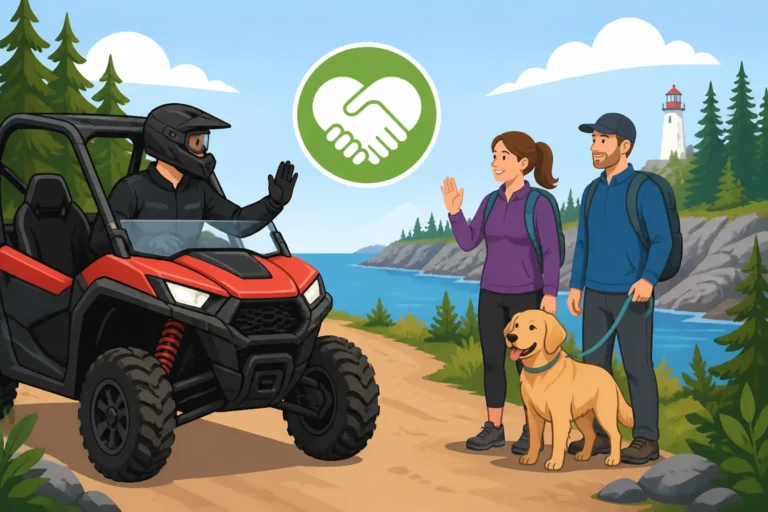
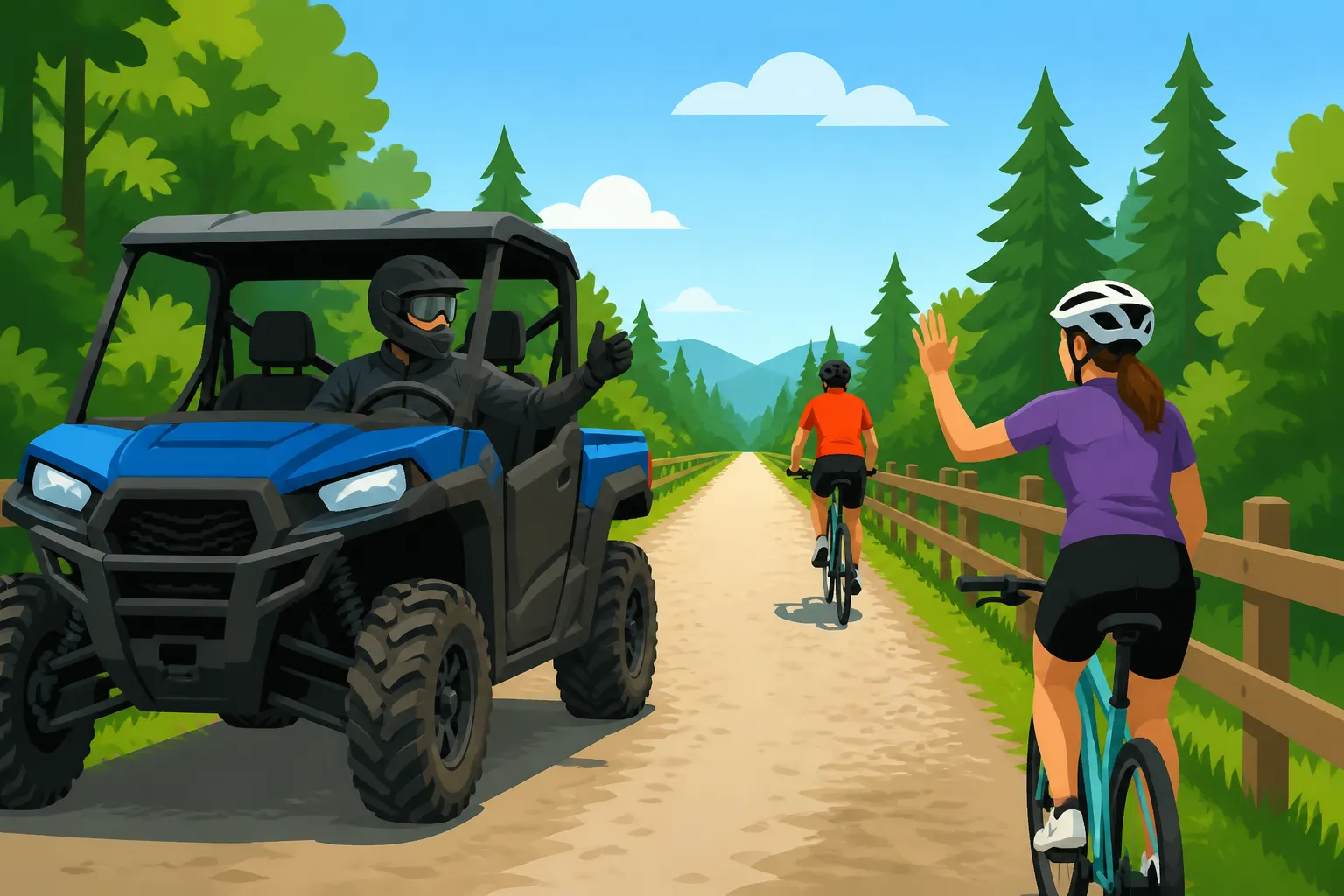
When you see cyclists ahead or approaching, reduce speed early and leave enough distance to respond to a wobble, a stop, or a change in position. Let them know you are there in a calm, understandable way, following any local signs or trail guidance. Avoid surprising them with a close approach from behind, especially if wind, engine noise, or nearby traffic may make it difficult to hear you.
Wait to pass until you have a clear view and enough room to do so without forcing anyone toward the edge of the trail. A cyclist may need more space than expected to steer around loose stone, a puddle, or a pothole. If the trail narrows, the surface is unstable, or people are approaching from the other direction, stay back until there is a safe opportunity.
A simple rule is to make the pass comfortable for the person being passed, not merely possible for the person driving. Passing Safely on a Narrow Coastal Cut offers a related perspective on giving other users room when the corridor is tight. The same patience is valuable on a rail trail, where a narrow bridge or soft shoulder can leave little margin for error.
Use extra care around groups and blind spots
A pair of cyclists may be followed by another rider several metres behind, or a family group may include children who change direction unexpectedly. Before passing, look beyond the first person and make sure the entire group has space to respond. If you are in a UTV, remember that passengers may have different sightlines than the driver, and the machine’s width can make a marginal opening feel much tighter to others.
If you meet cyclists on a bridge or another confined section, slow down and assess the space before entering. Where there is not room for a safe meeting, stop at a suitable spot and allow the other users to pass. Do not assume that a cyclist can easily move off the trail; the shoulder may be uneven, muddy, steep, or covered with loose rock.
Use extra caution at trail junctions, access roads, and spots where a rail corridor crosses a road. People may be looking at signs or deciding which way to go, rather than watching for an approaching machine. Make your approach slowly and give them time to understand what you are doing.
| Situation | Safer response | Avoid |
|---|---|---|
| Cyclists ahead on a clear, wide section | Slow down, give warning calmly, and pass only with ample room | Accelerating close behind them |
| Cyclists approaching on a narrow section | Reduce speed and wait for a suitable place to pass or meet | Trying to squeeze past |
| Dusty trail surface | Ease off early and leave time for dust to settle | Following closely or spinning tires |
| Blind curve or bridge approach | Slow down enough to stop within the visible distance | Assuming the corridor is clear |
| Group with children or mixed experience | Allow extra space and check that everyone is clear before moving | Passing the first rider without checking behind |
| Closed or unclear segment | Stop and confirm access through an appropriate local source | Relying on a map line alone |
Make the ride work for everyone
Follow the marked corridor and leave the trail as you found it
Stay on the designated route, even when another track looks smoother or easier. Riding around a puddle or soft patch can widen the disturbed area, damage the edge of the corridor, and create a rougher experience for cyclists and walkers. If a section is muddy or damaged, slow down and stay within the marked trail rather than cutting a new line beside it.
Pay attention to gates and barriers. If a gate is open for permitted trail access, pass through carefully and leave it as you found it. A gate may be there to manage livestock, vehicles, or access to private property, so do not treat it as an invitation to explore beyond the marked route. For more context about shared corridors and right-of-way, see Yielding on a Multi-Use Corridor.
The Nova Scotia ATV Trails: The ATVANS Network can help riders understand the broader trail network and the role of local trail organizations. Local clubs may also share information about maintenance work, temporary detours, or closures. If your route crosses a trail maintained by a club, following its posted instructions helps protect access for motorized and non-motorized users alike.
Help prevent conflict before and after the ride
Many trail conflicts begin with uncertainty: a cyclist does not know whether a machine is approaching, a rider assumes a segment is open, or someone encounters a group without enough room to react. Calm, predictable conduct can lower that tension. Reduce speed, give people space, and avoid revving or accelerating sharply near homes, parking areas, and trail entrances.
If a cyclist or pedestrian signals that they need you to stop, respond courteously. A few seconds spent waiting can prevent a close call and leave a better impression of riders who use the corridor. If you see a damaged sign, a blocked route, or a hazard that could put other users at risk, report it to the relevant local club or trail contact rather than attempting an improvised detour.
Keep your route planning flexible. If a shared stretch is busy, dusty, or too narrow for a comfortable ride, choose another confirmed motorized route or turn around safely. You can use onX Offroad to review possible alternatives, then verify that the alternative is open and appropriate before heading there. For downloadable route-planning resources, see Nova Scotia ATV Trail Map Downloads.
The goal is not to hurry past cyclists or claim more space than the corridor offers. It is to ride only where machines are allowed, make your presence predictable, and leave enough room for other people to enjoy the trail too. Checking access, reading signs, and slowing down when the trail gets crowded are small habits that can make a shared rail-trail ride safer and more pleasant for everyone.
Disclaimer
This article is for general informational purposes only and does not constitute professional advice. Laws, prices and regulations vary by location and change over time. Consult a qualified professional for guidance on your specific situation.