Hunting Season and Trail Sharing in Nova Scotia
Hunting season can make a familiar Nova Scotia trail busier and less predictable. Hunters may be moving through the woods, setting up away from the trail or using a permitted route to reach a hunting area. A little planning helps ATV and UTV riders avoid conflicts, respect land access and know when to turn around rather than press on.
What changes when hunting season begins
Hunting season does not automatically close every ATV trail, but it can change who is using the surrounding woods and how people move through them. A hunter may be walking, parked near a trailhead or travelling on an authorized route. You may also encounter a temporary closure, a gate or signs asking users to stay out of a work or hunting area.
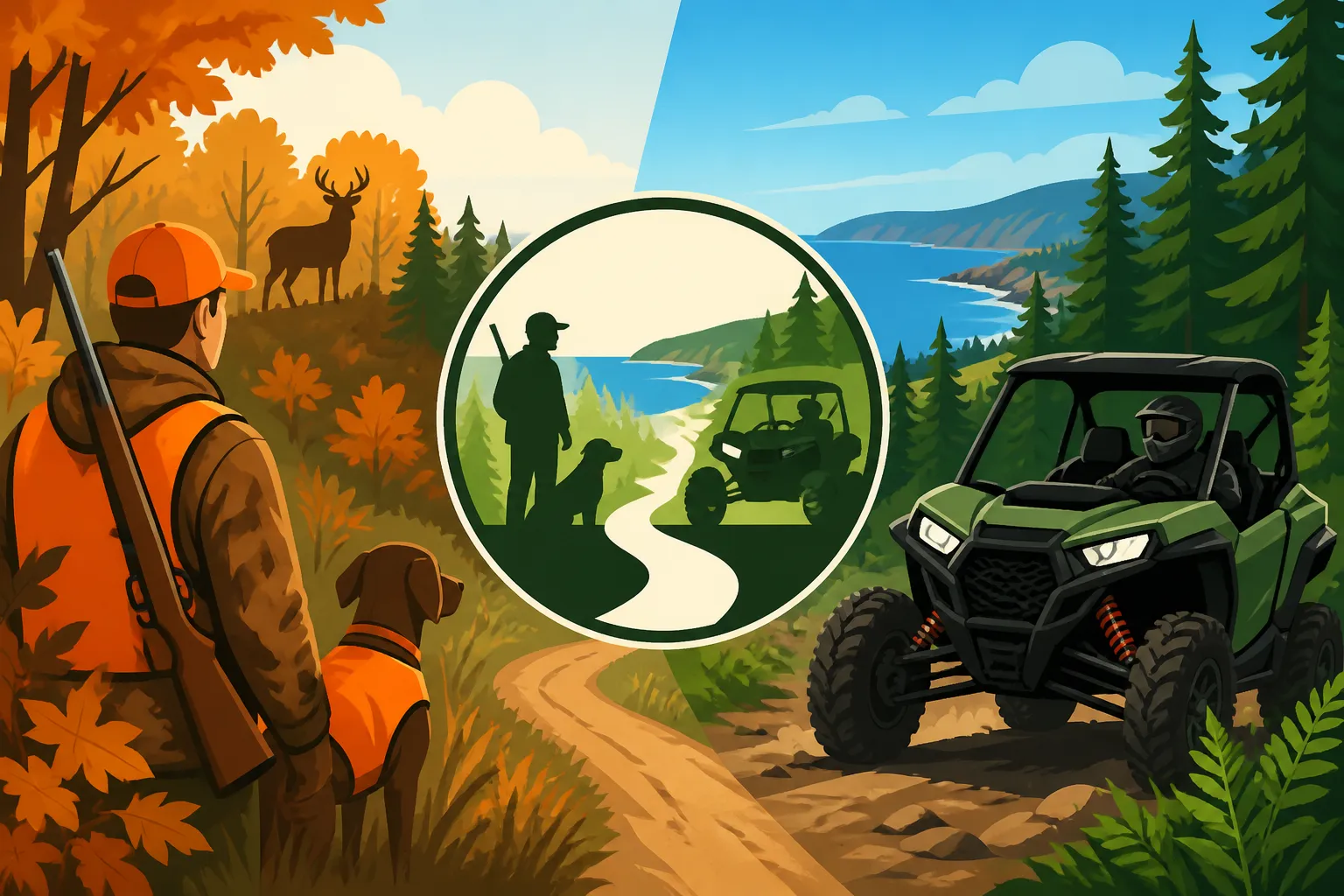
Treat the trail as shared space, not as an ATV-only corridor. Riders are easier to hear and see than someone moving quietly through the woods, but that does not mean a hunter will always know where you are. Trees, bends, terrain and engine noise can limit visibility and make it difficult to judge where another person is.
The important distinction is that hunting access and ATV access are not the same thing. Permission to hunt on land does not necessarily give you permission to ride there. Likewise, a trail that is open to ATV use does not mean every nearby woodlot, field or access road is open. The route you ride must still be authorized, and you must follow any posted restrictions.
Before heading out, check the status of the specific trail and access point you plan to use. A route that was open on your last visit may have changed because of a landowner request, maintenance, damage or a seasonal restriction. Club information and local notices can help, but check close to your ride rather than relying on an old map or a past trip. See Nova Scotia Trail Conditions and Closures and Nova Scotia Trail Maps Worth Downloading when planning a route.
Hunters and riders may also be using different parts of the same landscape. A marked trail can pass through or beside private woodlots, Crown land or other managed areas. Do not leave the marked corridor just because you see tracks, a path or a place where a vehicle could turn. If you are uncertain whether a segment is open to machines, stop and confirm rather than guessing.
| What you encounter | Safer response |
|---|---|
| A hunter near the trail | Slow down, give the person room and wait for a clear signal before continuing |
| A closed gate or closure sign | Stop and respect it; do not go around or move the barrier |
| A vehicle parked beside the trail | Reduce speed and expect people to be on foot nearby |
| A route crossing private land | Stay on the authorized trail and follow posted conditions |
| Unclear trail status | Turn back or confirm access before proceeding |
| A person carrying hunting equipment | Keep distance, avoid sudden movements and communicate calmly |
If you want to understand how trail access and land permission fit together, review Nova Scotia Crown Land Riding Rules and Nova Scotia Private Woodlot Permission. Neither the appearance of a trail nor the presence of other riders is proof that you have permission to use a particular route.
Check permission, trail status and seasonal conditions
Start by confirming that your route is open to your type of machine. A trail association, land manager or posted sign may identify restrictions, but the exact source depends on who manages that section. If a route crosses private land, permission and conditions from the landowner matter. If it is a club trail, check the club’s current notices and permit requirements. Nova Scotia ATV Trails: The ATVANS Network can help you understand the club-trail context, while Nova Scotia Trail Permits From ATVANS covers permits for that network.
Do not assume that a trail permit gives permission to hunt, enter adjacent land or ride an unmarked connector. A trail permit concerns access to eligible trail corridors under their applicable rules; it is not a general land-use pass. Keep your route within the marked corridor unless you have separate, clear permission for another area.
Seasonal hunting activity can overlap with other reasons a route is restricted. Landowners may close access, clubs may reroute around damage, or managers may post limits for safety or maintenance. Fire restrictions and woods bans can also affect where people may go and what activities are allowed. Check current notices before departure and follow them even if the trail looks passable. For related precautions, see Nova Scotia Fire Restrictions and Woods Bans and Nova Scotia Club Trail Maintenance.
A practical pre-ride check should include:
- Confirm the route is open. Check for recent closure or reroute notices, and look for signs at the trailhead and along the corridor.
- Confirm your machine is allowed. Do not assume every route permits every type of off-highway vehicle.
- Check access conditions. If a trail crosses private land or has a gate, follow the landowner’s directions and leave barriers as found.
- Review the day’s conditions. Weather, poor visibility, mud and damaged sections can make it harder to stop or turn around safely.
- Tell someone your plan. Share your intended route and expected return time, especially if you are riding somewhere with limited cell service.
- Carry the documents and equipment you need. Keep required registration, insurance and trail-permit information accessible, and make sure your machine is ready for the route.
If hunting activity is visible at the trailhead or in the area, take that seriously. A line of parked vehicles may mean people are on foot nearby, even if you cannot see them. Do not block access, move someone else’s vehicle or assume that an empty-looking trail is clear. Choose another route if the situation feels crowded or uncertain.
How to share the trail safely
Reduce speed whenever you approach a person, parked vehicle, blind corner, junction or area where a hunter may be working. Go slowly enough to stop within the distance you can see. On a narrow trail, be ready to stop and let a person on foot move to a safe place. Do not use the horn or rev the engine aggressively to make someone move.
Make yourself visible without creating a new hazard. Wear suitable high-visibility clothing, keep your lights working and avoid approaching people at speed. Visibility clothing is a sensible precaution, but it does not replace the responsibility to ride cautiously or follow any applicable equipment rules. Nova Scotia Trail Etiquette Locals Expect offers broader advice for sharing corridors with other users.
If you see a hunter, pause at a safe distance and make your presence known in a calm, ordinary way. Give the person time to notice you and respond. Do not drive toward a firearm, reach for equipment or try to pass closely. If you cannot tell whether the person has seen you, stay stopped and wait. When the trail is narrow or visibility is poor, turning around may be the safest choice.
Keep your group together and under control. Riders spread out over a long distance may not hear one another, and a hunter may encounter the lead rider before the rest of the group has passed. Agree on a low speed for the area, leave space between machines and stop together if someone signals a concern. A lead rider should tell the group about people, vehicles, signs or closures ahead rather than assuming everyone has seen them.
Avoid unnecessary noise. A loud or modified exhaust can disturb people and wildlife and may violate noise requirements. Do not race, spin tires or accelerate hard near homes, camps, trailheads or people on foot. Nova Scotia Sound Limits on Trails explains why quiet operation matters beyond hunting season.
If you encounter a closed gate or a sign, do not treat it as an obstacle to get around. Do not ride through a field, around a barrier or along a parallel path to avoid a closure. A closure may protect a landowner’s property, a damaged trail or people working nearby. If there is no clear alternate route, turn back and report the issue to the appropriate club or land manager once it is safe.
Also leave hunting equipment and property alone. Do not touch, move or inspect a tree stand, blind, trail camera, vehicle, bag or other equipment. Do not stop to investigate activity away from the trail. Stay on the authorized corridor and give people the privacy and space they need.
A simple plan for a shared-trail ride
A hunting-season ride does not need to be complicated. The safest approach is to choose a confirmed route, ride conservatively and have a clear plan for changing course if you meet people or signs of activity.
Before leaving, tell your group that the route may be shared with hunters and agree on a few basics: ride slowly near trailheads and blind corners, keep the group close enough to communicate, and stop if anyone spots a person or a closure. Make sure every rider knows that the group will turn around rather than bypass a gate or enter an uncertain area.
At the trailhead, look for signs and parked vehicles. Use the designated parking area without blocking an entrance or access road. If people are preparing to head into the woods, give them room and do not assume they are finished simply because they are not standing on the trail.
On the trail, stay in control and pay attention to changes in the surroundings. A fresh vehicle track or footpath can indicate activity, but it does not authorize you to follow it. Slow down at bends and intersections, and do not stop where another rider cannot see you. If you need to pull over, choose a place where your machine is visible and does not block the corridor.
If you meet a hunter, stop at a comfortable distance. Wait for the person to acknowledge you, then ask whether it is safe to pass if the trail is narrow or the situation is unclear. Keep the exchange brief and courteous. If the person asks you to wait or turn around, do not argue on the trail. Move away safely and contact the trail manager later if you need clarification about access.
If the route is closed, use the same rule: stop, comply and choose another open route. Do not rely on a map downloaded months ago, a friend’s recollection or tracks made by another machine. For multi-use trail basics, see Nova Scotia Trail Etiquette Locals Expect. If you are uncertain about what a rider may be asked to show, Nova Scotia Insurance Proof at a Trailhead can help with the separate question of carrying insurance evidence.
Use this quick decision process whenever access or safety is uncertain:
- Stop before entering the uncertain area. Do not ride closer just to get a better look.
- Read the sign or assess the situation from a safe distance. Look for closures, landowner directions and people on foot.
- Confirm the route if you can. Contact the relevant club or manager rather than relying on assumptions.
- Choose the conservative option. Wait, reroute on an authorized trail or return to the trailhead.
- Report a problem afterward. Share the location and what you observed with the responsible organization, without disturbing people or equipment.
The goal is not to avoid every trail during hunting season. It is to recognize that a route can be shared, that access rules still apply, and that a brief delay or detour is better than startling someone or entering land without permission. A courteous rider helps keep trails usable for everyone.
Disclaimer
This article is for general informational purposes only and does not constitute professional advice. Laws, prices and regulations vary by location and change over time. Consult a qualified professional for guidance on your specific situation.